RSS
RSS
|
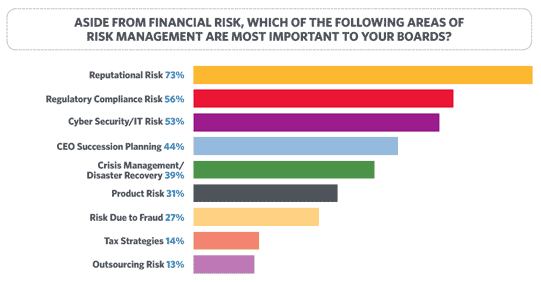
By: Bailey McCann, Private Equity Strategies In our data snapshot this month, we are looking at new challenges facing corporate boards following a survey by accounting firm EisnerAmper. In that survey, data shows that reputational risk is the top concern for corporate boards, increasing some 20% over the last four years to take the top slot. The findings in this survey highlight critical differences between public and privately held companies.
More than 230 board members participated in the survey. In addition to responses from public and private boards, directors from not-for-profit and private equity-owned boards replied to the survey. Sixty percent of the directors identified themselves as serving on audit committees. Other than financial risk, respondents were asked to identify risks of most concern. Seventy-three percent identified reputational risk as a primary concern of their boards – a 19% increase in the number of board members who identify this as their greatest concern since the initial Survey, four years ago. Playing into the idea of reputational risk, the three core areas respondents said they were most concerned about were: product quality, liability and customer satisfaction; public perception and brand; integrity, fraud, ethics and the Foreign Corrupt Practices Act (FCPA). On the private equity side, the data isn’t great. Private company directors are far behind their peers in pushing for diversity in board membership. Only 33% of PE-owned directors indicated their boards took action to increase board diversity last year vs. 50% for public companies and non-profits. This has been the case for a while in private equity and unfortunately doesn’t seem to be improving. In last month’s issue, we highlighted a case study and video from the Center for Audit Quality, which pointed to some indicators of fraud in public companies, including lax internal audit standards. On the private equity side, this can be harder to ferret out, and report data shows that may be related to the lack of internal auditing at all in private companies. Private-equity owned entities don’t use internal audit to identify risk as their public company counterparts do. Despite the closing the IPO window and increasingly complexity of risk management, only 31% of PE-owned directors found internal audit helpful vs. 51% of public company directors. Directors at PE-owned companies were also more likely to report outsourcing the entire function and were less likely to report any changes. The emergence of social media is also putting pressure on all of these factors. Recently, the Securities and Exchange Commission, authored some new guidance around the use of social media for financial firms. In that guidance, the regulator noted that communications with the public about already public information, or information that was not directly linked to a sale or transaction was ok for social media. However, survey respondents said that social media is another top concern. “Social media exacerbates all of the major risk categories we track – financial, regulatory and compliance, fraud, privacy, and data security,” said Steven Kreit, a partner in EisnerAmper’s Services to Public Companies practice. “Social media’s immediacy turns routine challenges into enterprise risks and boards need to be ahead of the curve on digital risk management to understand these threats.” Social media has become a key part of non-profit and public company communications about its brand and customer service, and private companies as well as private equity firms are also getting into the mix, but planning is critical. Social media behaves much like any other reputational risk factor, but its threat is magnified by how quickly information can spread and how difficult it is to regain control. “Awareness and vigilance in addressing threats are shared by both boards and executives. Directors should have knowledge of the tools available to mitigate risk but implementation remains the role of management,” Kreit said. *Image Source: EisnerAmper
| |
|
This article was published in Opalesque's Private Equity Strategies our monthly research update on the global private equity landscape including all sectors and market caps.
 


|
Private Equity Strategies
Data Snapshot: Reputational Risk Takes Top Slot of Board Concerns – Survey |
|