|
Matthias Knab, Opalesque for New Managers: While the big US platforms spent the past decade bidding for portfolio managers, a London firm founded in 2011 took the long way round. It built a fintech credit machine first, then let it fund close to 200 independent alpha pods across private credit, digital assets and quant. Opalesque visited the team.
For most of the past decade, the multi-strategy story has been told as an arms race. The large US platforms competed for portfolio managers with guaranteed payouts and signing packages, and the bill increasingly travelled through to investors as pass-through fees. Scale, in that model, is something you buy.
Fasanara Capital took the other route. The firm, founded in 2011 by Francesco Filia after 15 years at JP Morgan and Merrill Lynch, did not raise a war chest to outbid anyone for talent. It built a fintech credit business first - one that today finances hundreds of thousands of small businesses and consumers through 139 origination platforms in more than 60 countries - and let that engine fund everything that came after: a market-neutral digital assets franchise launched in 2018, a quantitative multi-manager platform, and a multi-strategy fund that holds all three in one semi-liquid portfolio.
Count the parts from the top down and you arrive at close to 200 independent, uncorrelated pods, internal and external. That makes Fasanara, in our reading, Europe's most granular home-grown multi-strategy platform. It also makes the firm, by its own cheerful admission, a little confusing.
"One thing that we are really very happy to see is when investors say, 'Fasanara does a lot of different things in different directions. What is the common denominator?' It's almost confusing to some of the investors. And to some extent we like it, because it means that we have done something that other people failed to scale up, failed to implement, failed to execute spotlessly on," says Filia.
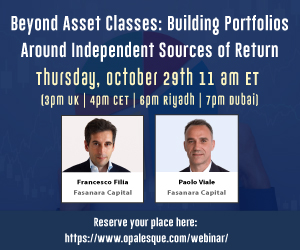
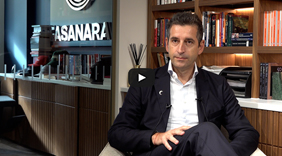
This profile is an attempt to find that common denominator. It draws on an Opalesque Virtual Manager Visit filmed at Fasanara's London office in Mayfair, in which Filia and his senior team walked through each of the firm's engines, and on Opalesque's earlier coverage of the firm. On October 29, Filia and Paolo Viale will take the argument further in an Opalesque investor workshop - details at the end of this article (for sophisticated investors only).
Two bankers and the asset classes nobody wanted
Fasanara's origin story is short on romance and long on intent. "I had been for 15 years in banking, JP Morgan and Merrill Lynch, and the idea was, together with a colleague from Merrill Lynch, to set up Fasanara as an asset manager, hedge fund, looking at the next available business opportunity," Filia recalls. The opportunity they settled on was not a market view but a method: "to dedicate ourselves to innovation and technology within asset management."
That meant deliberately choosing asset classes that were awkward to handle. "We dedicated ourselves to niche asset classes, which were difficult to deal with, difficult to frame and create risk management around," he says. Fintech lending looked like an under-market that could not be standardized. Digital assets, in his words, "were a curse word when we first started looking into it." The quant business "took years to get across in the right format."
What carried the firm through, Filia argues, was not a single insight but staying power: a group of partners that stuck together through good and bad markets and kept the cultural alignment high. "It didn't happen overnight. It took literally most of the 15 years that we've been around."
The goal underneath all of it has not changed: manufacturing stable income for institutional investors at a time when, in Filia's view, it has become a scarce commodity. "Equities are in bubble territory and overly volatile. Bonds are incredibly volatile. You have seen what happened to interest rates," he says. "So the question for Fasanara was, how can we manufacture a stable income which is sustainable, which is scalable, and which also benefits the real economy as we do that?" His answer is a firm-wide bias to market neutrality: "We don't take punts. We don't speculate up and down the markets."
The engine room: small tickets, short duration
The credit business rests on two choices that sound conservative and turn out to be operationally brutal. Fasanara lends short - loans and receivables that are typically outstanding for a few months - and small, in tickets that individually barely register.
Filia makes the risk case in two sentences. On duration: "Short duration means that you can change your mind and redeploy your capital multiple times a year. You don't need to be extremely right on day one." On ticket size: "If you are wrong, you're wrong on a small scale."
The catch is scale. A book of small loans that replenishes every three months has to be rebuilt, in effect, four times a year. Doing that across thousands of borrowers is a data and software problem before it is an investment problem. Fasanara's answer was to aggregate origination through a network of fintech lenders, each originating in its own jurisdiction under its own credit box and investment management agreement, and to build the infrastructure that standardizes what comes back. Today the firm holds over 7 million positions in short-duration loans, works with 139 platforms in over 60 countries, and manages around USD 7.5 billion.
Elisa Bianchi, Chief Commercial Officer and Head of Impact at Fasanara, describes what that means in practice: "Because we are doing short-term loan financing to hundreds of thousands of SMEs, it is impossible to track them one by one otherwise. [...] For some mandates we have to collect the gender data on each SME, or the sub-sector, or the specific location where they are, or many other sets of data." For investors with impact or reporting requirements, that granularity is not a nice-to-have; it is what makes the mandate possible at all.
The result, as Filia describes it, is a portfolio that is "extremely diversified and on a very short duration, and does not require leverage to achieve its target returns." The firm has told Opalesque that its flagship credit strategy has not had a down month in 12 years.
Capital for the economy the banks left behind
Fasanara frames the credit engine as more than a yield product. Small businesses and consumers, Filia argues, are "neglected by traditional banking channels," which leaves a funding gap in the real economy that private capital can fill "for productive use," with knock-on effects on employment.
The firm has also pushed the same logic onto new rails. "We have experimented across blockchain technology. We have experimented successfully, and today we are one of the largest funds in tokenized real-world assets," Filia says. It is a claim worth noting less for the ranking than for what it shows about the firm's habit: test the new infrastructure early, with real assets, rather than wait for the industry to settle on a standard.
Entrepreneurs on top, an institution underneath
Private credit, crypto market-making and systematic trading need different people and, as Filia puts it, "to a certain extent also different ways of thinking." So how does one firm house them without either smothering the specialists or losing control?
The answer is a deliberate split. "We give ownership of the investment strategy to the investment teams, and we let them act independently," Filia explains. "At the same time, underneath them, there is a common shared institutional infrastructure" - risk, operations, legal, compliance, data, analytics, technology, AI, finance, HR, talent and administration. Every team trades its own book, but to the same standards and inside the same framework.
The pay-off is speed. Because the backbone is shared, new strategies and new talent "can be seamlessly integrated into the machine without us having to reinvent the wheel every time," a senior member of the team adds. "The real test of a growing business is to be able to manage this complexity [...] while maintaining the same speed of execution, accountability, and discipline."
Filia sees the difficulty of the journey as the moat. "Once you have gone through that and you have been able to execute on it, you have very big barriers to entry that can protect your business." Counted from the top down, the firm now runs "more than 200 pods which are uncorrelated, creating uncorrelated streams of income" - a degree of granularity, he notes, that is "difficult to replicate for a firm of our size."
Three engines, one portfolio
The firm offers clients two ways in. They can buy the engines separately - credit, digital or quant - or they can buy them together in what Fasanara calls a next-generation multi-strategy vehicle, Fasanara One (F-ONE), which combines the credit foundation with market-neutral digital asset strategies and the quantitative platform.
"It's rather unusual to be able to offer clients a one-stop shop solution that provides, in a semi-liquid format, exposure to off-chain, on-chain, private and public exposures, all underpinned by the same Fasanara technology," says Paolo Viale, CAIA, Head of Business Development. Most hedge funds, he points out, either operate within traditional public markets or ring-fence niche strategies in separate teams. Fasanara's pitch is that the three engines respond to different drivers - real-economy cash flows, crypto market structure, systematic signals - and that putting them under one risk system lets capital move between them.
Open Quant: an access product for alpha that cannot scale
The quant platform answers a problem allocators know well. Many of the most interesting systematic strategies are run by small, emerging managers, and they are interesting precisely because they are capacity-constrained. They are too small for a large platform to bother with, and too operationally thin for most allocators to diligence one by one.
Fasanara Open Quant is built to bridge that gap. "The first [element] is a technology platform designed and built by Fasanara as a decentralized execution platform, where we can access these external managers via managed accounts, with full control, transparency, and better return on capital, in a centralized portfolio and risk management system," explains Vinicius Karam, Managing Director and Head of Fasanara Quant. "The second key component is our quant network. Over the years, we built a network of hundreds of emerging managers."
The fund currently has 32 external strategies invested and more than 150 in the pipeline. In August, Fasanara hired Dr Darran Specter as Head of Quant Equity to widen the search. Specter spent more than 11 years at the Abu Dhabi Investment Authority overseeing multi-billion-dollar allocations to systematic hedge fund strategies, followed by two years at Brevan Howard building manager evaluation and capital allocation frameworks - in other words, a career spent on the buying side of exactly this problem.
Fasanara Digital: eight years early to 24/7 markets
Fasanara Digital was set up in 2018 as a market-neutral liquidity provider, at a time when most institutions kept crypto at arm's length. "We saw fragmented liquidity, 24/7 price discovery, and an extremely volatile asset class to trade. And so where people saw risk, we saw opportunity," says Nikita Fadeev, Managing Partner and Head of Fasanara Digital.
The business monetizes market inefficiencies rather than direction: "seamlessly sourcing liquidity from where it is abundant and relaying it to where it is in deficit." That requires a fast trading stack and sophisticated algorithms, but Fadeev's larger point is about where the market is heading. As tokenization moves part of price discovery onto digital venues, he expects established financial institutions to migrate toward the kind of always-on infrastructure the team has been running since 2018. "The trading universe for us is growing," he says.
The three risks Fasanara designs out
Asked why investors should regard a firm doing so many things as a safe pair of hands, Fasanara's answer is a list of three risks it tries to remove at the design stage rather than manage in a crisis.
Concentration. "Diversification is not aspirational. It's hard work," Paolo Viale says. "It means that you need to put in the effort to build the infrastructure, the trading capabilities, and the expertise to be able to truly manage a highly diversified portfolio." Bets are spread across countries, sectors, maturities and currencies.
Long duration. All exposures are liquid or semi-liquid, with monthly or quarterly dealing, and the funds are open-ended. That, the firm argues, avoids the lock-ups and illiquidity typical of concentrated private market portfolios.
Leverage. Fasanara uses very little across credit, digital and quant, and most of its credit products are unlevered. "Leverage, as we know, is a great tool, but it can backfire very quickly," Viale says. "Being able to deliver high single-digit returns unlevered is a safe bet for investors."
Good due diligence will still want to go further, and the firm's own framework suggests where. A network of 139 originators is diversification, but it is also 139 counterparties whose underwriting, servicing and solvency need watching through a credit cycle. Semi-liquid funds are only as liquid as their redemption terms in a stress scenario. And a platform of some 200 pods is, by construction, an operational undertaking as much as an investment one. These are the questions a firm like Fasanara expects to be asked - and the shared institutional backbone is its answer to them.
Who is buying - and who is coming next
Around 90% of Fasanara's investor base is institutional, historically concentrated in Europe, Japan and parts of Canada. That is changing. In June the firm opened its first US office, at Rockefeller Center in New York, and hired Cameron Arrington, a 21-year Goldman Sachs veteran, as Head of US Capital Formation. "We have a large demand from US investors coming to us, and we need to be able to cover those investors," Viale says.
The second shift is toward private capital. "Although the institutional side of our investor base is the vast majority, we see also strong demand recently coming from the private capital side, family offices, wealth managers, and so on." What they want is the same as what pension funds and insurers want - return streams that are de-correlated from the 60/40 core and from the other managers in the alternatives bucket - but packaged differently. "An insurance company and a family office have very different risk-return objectives," which is why the firm offers customized solutions alongside its funds.
From silos to the total portfolio
The most interesting part of Fasanara's argument may be the one with least to do with Fasanara. For years, large allocators organized themselves in silos: a public equity team, a private equity team, a private debt team, fixed income, commodities, infrastructure. "All these boundaries are coming down," Viale says. "When we talk about a total portfolio approach, it means looking at your investment portfolio and detaching yourself from labels, focusing on what is truly diversifying."
When Opalesque spoke to Viale at the SuperReturn conference in Berlin, he described the same shift from another angle: away from valuation-based investing and toward cash-flow-based investing. For a family office, the implication is uncomfortable but useful. Two holdings filed under different asset-class labels can share the same failure mode - the same rate sensitivity, the same liquidity squeeze, the same crowded trade. Two holdings filed under the same label can have nothing in common. A family that intends to last for generations is better served by counting its independent sources of return than by counting its asset classes.
"Innovation for us means thinking of what is relevant for investors 10 years ahead," as Viale puts it.
The harder thing to copy
Fasanara's model is not the only way to build a multi-strategy business, and it is not the fastest. A firm with a large enough cheque book can hire a hundred portfolio managers in a year. What it cannot buy as easily is fifteen years of plumbing: the origination network, the data standardization, the managed account infrastructure, the 24/7 trading stack, and a partnership that stayed together long enough to build them.
That is the wager. In an industry that has learned to buy scale, Fasanara is betting that the slower thing - building the machine first - is also the harder thing to copy.
Join the conversation: Opalesque Investor Workshop with Fasanara Capital
Beyond asset classes: building portfolios around independent sources of return
Thursday, October 29, 2026 - 11:00 am ET | 3:00 pm UK | 4:00 pm CET | 6:00 pm Riyadh | 7:00 pm Dubai
Speakers:
- Francesco Filia, Founder, CEO and CIO, Fasanara Capital
- Paolo Viale, Managing Director and Head of Business Development, Fasanara Capital
- Vinicius Karam, Managing Director, Head of Fasanara Open Quant
- Nikita Fadeev, Managing Partner, Co-Head of Fasanara Digital
Would you diversify better by source of return than by asset class? In this interactive masterclass, Francesco Filia and the Fasanara leadership team will explain how the firm builds its F-ONE platform around three engines - asset-based finance, market-neutral digital assets and a quantitative multi-manager platform - and discuss dynamic capital allocation, risk contribution, liquidity across different holding periods, and what allocators should measure beyond returns. The session will not predict market direction.
For institutional allocators, family offices, wealth managers, consultants and sophisticated investors. Registration is free; a user-friendly video replay will be provided.
Register free here
This live session contains advanced concepts and is intended for sophisticated investors only. Past performance of any strategy discussed does not guarantee future results.
Watch the full Opalesque Virtual Manager Visit: Inside Fasanara Capital: How Europe's most granular multi-strategy platform was built from fintech credit
This article is for information purposes only and does not constitute an offer or solicitation to buy or sell any investment. Past performance does not guarantee future results. Statements about performance, assets and positions are as provided by Fasanara Capital.
|


 RSS