|
Matthias Knab, Opalesque: "For once, AI doesn't mean artificial intelligence - it means alternative investment"
Opalesque was a Media Partner of SuperReturn International 2026 in Berlin, with Opalesque founder Matthias Knab participating. As the world's largest and most influential conference for private equity and venture capital, more than 2,000 LPs (Limited Partners) managing over $50 trillion in assets and over 3,000 GPs (General Partners) are represented.
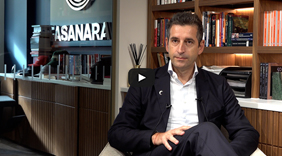
At the last day of the conference, I had the opportunity to speak with Fasanara Capital's Paolo Viale on running the world's largest network of fintech lending platforms, why risk management starts at the design stage, the new Ferrari-backed lending strategy, and the move from valuation-based to cash-flow-based investing.
Paolo Viale, CAIA, is managing director and head of business development at Fasanara Capital, the London firm founded by Francesco Filia in 2011 that has spent the better part of a decade turning fintech lending into an institutional asset class. Its model is a platform of platforms: a global network of non-bank originators feeding portfolios of hundreds of thousands of short-duration loans, run with a risk discipline inherited from the firm's hedge fund roots.
Three competitive edges
Matthias Knab: What's the most exciting thing about Fasanara right now - the one thing you'd want to talk about today?
Paolo Viale: It comes down to our position in the market and a value proposition built on three edges. The first is that we can give investors granular exposure to private debt in a semi-liquid format. That's possible because our business model runs the largest global network of fintech lending platforms, which we use to originate a critical mass of short-term loans, receivables and private debt exposures. Running the largest platform means real diversification - across countries, sectors, debtors, rating profiles and currencies. That's a very different proposition from a traditional direct lending fund, which runs highly concentrated, long-duration portfolios.
The second is that technology isn't a nice-to-have here; it's the enabler of the strategy. You simply could not run portfolios of hundreds of thousands of private-market positions in a semi-liquid format without the platform we've built.
And the third is that, on top of that platform, we apply new AI models to risk modeling and risk management - a quantitative approach to private markets that's quite rare in this space. That's why Fasanara is seen not just as a market leader but as an innovator.
Diversification by the hundred thousand
Matthias Knab: How many positions are you actually running?
Paolo Viale: In our flagship strategy, around 700,000 positions. In our multi-asset credit portfolio, over four million line items. So diversification isn't aspirational - it means putting in the hard work to build a genuinely diversified portfolio of alternative credit exposures.
Matthias Knab: Where do you sit in the credit origination landscape?
Paolo Viale: There are broadly three types of debt origination. The first is bank-sponsored - CLOs, ABS, traditional banking products. The second is sponsor deals on the back of private equity - private debt lending to large corporates, similar to direct lending. The third is our own category: fintech origination. We pioneered the space, and the moat we've built between us and our competitors is wide enough that investors appreciate it's a difficult model to replicate.
Risk first, returns second
Matthias Knab: Your founder, Francesco Filia, comes from the hedge fund side originally, and you can see a very developed risk discipline carried into private markets. Is that fair to say?
Paolo Viale: Absolutely. It makes sense to focus on risk rather than return, because returns are uncertain and risk is something you can control - you're more in charge of risk management than of capturing uncertain returns. In our case risk management is embedded in the design of the strategy itself, through three pillars: diversification, short duration, and little or no leverage. Get those right and, whatever strategy you're running, you're already in a good place, because you've built a resilient portfolio: diversified, liquid, and unlevered.
Even when there have been negative headlines in private credit and worries that the historic default rates we've seen could eventually double, with recovery rates coming down - that negative convexity some of our peers carry - we think we can manage it well, precisely because of those three dimensions.
We're not here to deliver 20% returns with 20% volatility. We're in the business of high-single-digit unlevered returns, or double-digit with some leverage, depending on the product. And for once, AI doesn't mean artificial intelligence - it means alternative investment. We're in the business of delivering low-beta, uncorrelated, stable returns, and you only deliver stable returns by being roughly market-neutral. Our neutrality comes from systematic arbitrage in credit and from having the systems to exploit inefficiencies at scale, depending on the asset class.
Fasanara One
Matthias Knab: Tell me about Fasanara One.
Paolo Viale: F-ONE is our next-generation multi-strategy product - a hedge fund that brings together the best of Fasanara's capabilities in alternative credit, digital assets and proprietary trading, all blended into a single access point. It goes back to the fundamentals the firm was built on: systems theory and the network effect. If you build a system that can harness alpha - whether from credit and rating arbitrage, from inefficiencies in digitalized markets, or from the emerging alpha we capture through our multi-manager platform before it gets crowded and diluted - it puts you in a very nice position.
The Ferrari facility
Matthias Knab: Fasanara was in the news recently because you started a platform to finance vintage, racing and classic cars made by luxury brand Ferrari. That was making some waves through the industry!
Paolo Viale: For sure - though our prospects were probably more excited than we were, because we knew it was coming and they didn't. It's an example of our ability to generate lending exposures through different types of origination. This particular facility is aimed at luxury-car lovers, with Ferrari as the obvious first example. We're an Italian firm, and Francesco is from Ferrari's home region, so it's close to his heart - but the real point is that it's just one more origination type we can include in a multi-strategy or credit-only portfolio. Sports and luxury-asset lending are drawing more and more interest in the market, and the more origination types we add, the more diversified the overall portfolio becomes.
Monitoring 700,000 positions
Matthias Knab: When you're running hundreds of thousands - or millions - of line items, is there monitoring taking place, and how do you react when something isn't going well?
Paolo Viale: Risk management isn't done in the moment of stress; it starts when you design the strategy and build the portfolio. Once you have a well-diversified book, you can tactically shift exposures from one country or sector or risk dimension to another, and we can do that because our exposures are short-duration - three to six months on average. So we're not very sensitive to interest-rate changes, or to a shock in one specific country or sector, and we can rotate the portfolio as the opportunity set changes. That's quite unexpected for a private-market manager, where you'd assume a static, long-duration book.
Take the recent disruption in software. Software-as-a-service names took a big drawdown as AI began to bite - look at some of the brand names and indices in technology. Because of our diversification we had very little exposure to those names. And AI will be cross-sectional: it will disrupt software first, as the usual suspect, but then energy, transportation, real estate. No one knows where the next crisis will come from or what the trigger will be - so diversification really is your only free meal.
Geography, and the total-portfolio shift
Matthias Knab: How are you diversified geographically?
Paolo Viale: We use 141 fintech lenders - non-bank financial institutions - as conduits to finance small and medium enterprises across 60 countries. There's a tilt: around 60% of our exposures are across Europe and the US, but with very little concentration in any single originator or country. By type, we lend across corporate, consumer, real estate and sports - Ferrari being a good example of the newer streams of origination we apply.
Matthias Knab: What's the bigger message you're bringing to LPs here at SuperReturn?
Paolo Viale: We're marking 15 years this year, and we've never had a down month in 12 years in our flagship credit strategy - and that's because of risk management. Delivering stable, uncorrelated returns is exactly what institutional allocators and private capital are seeking, so we think the demand is there. The challenge for us is the educational journey: helping prospective investors understand the benefit of these strategies versus more traditional asset-allocation models.
What we're seeing is a shift away from the old strategic asset-allocation model - where you attach labels to asset classes and strategies - toward a total-portfolio approach, where you seek diversification not just at the asset-class level but at the strategy level: combining private and public markets, traditional finance and digital assets, in a semi-liquid format. That resonates strongly with the LPs we've met here, some of the largest institutions in the world. Historically they were divided into silos - separate teams for hedge funds, public equity, private equity, infrastructure, real estate. Now those silos are coming down, and there's a far more holistic approach: forget the labels for a second and look at the underlying return drivers.
From valuations to cash flows
Matthias Knab: A final thought on where the market is heading?
Paolo Viale: We've come through a long zero-yield era and one of the longest equity bull markets we've ever seen, which has created valuation bubbles. From our conversations, we notice a shift away from strategies focused on valuations toward strategies focused on cash flows. That's Fasanara: asset-based lending built on self-liquidating, contractual cash flows, collateralized by underlying assets or financial contracts.
Our short duration comes precisely from those self-liquidating cash flows - receivables and short-term loans backed by financial cash flows. Moving from a valuation-based mindset to a cash-flow-based one is, I think, a real turning point in how investors think about collateral, risk and the security behind their exposures.
|





 RSS
RSS