|
|

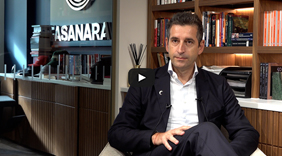
Sebastian Helmensdorfer Matthias Knab, Opalesque for New Managers: Most alternative strategies promise uncorrelated returns - and then quietly correlate when markets need them most. Amfileon AG, a Munich-based quantitative investment manager, was designed from the start to do the opposite: not just survive market stress, but exploit it.
Since going live in October 2023, the firm's flagship market-neutral strategy has delivered 7.7% annualized returns with 4.9% volatility and a Sharpe ratio of 1.6.
Those numbers are creditable on their own. But they miss the real story.
In high-volatility regimes - defined as periods when the VIX exceeds 21 - the strategy has delivered 23.6% annualized returns with a Sharpe ratio of 2.8. The beta to the S&P 500 is -0.03. Maximum drawdown since inception: 4.9%.
This is not a tail hedge that bleeds in quiet markets and pays off once a decade. It is a strategy explicitly engineered to perform well every year - and especially well when equity markets go south.
A Family Office Problem That Became a Strategy
Amfileon was founded in 2021 as a spin-off of a German wealth management family office, and the origin story matters for understanding why the strategy is built the way it is.
Dr. Sebastian Helmensdorfer, CFA, the firm's Founder and Co-CEO, was previously CIO at the family office, which carried an equity allocation of around 70% and was looking to reduce that exposure. "They were basically looking to diversify the equity exposure," Helmensdorfer explains. "And in the UCITS space, at the time, even now, there was not that much on the liquid alternative side that they thought was interesting. Many of the existing liquid alternatives were inherently correlated to equity performance."
The mandate he was handed was precise: build a liquid alternative that generates positive returns every year, and performs particularly well when equities fall. Not a tail hedge, not a volatility carry strategy, but something that would reliably generate crisis alpha without requiring a black swan to justify its existence.
"We decided that statistical arbitrage has the potential to fulfill all these conditions," Helmensdorfer says. "There are funds with decades of decent performance - and performance that is especially good in highly volatile environments." Amfileon was built to be one of them.
The Mechanics of Crisis Alpha
Statistical arbitrage is one of the most crowded systematic strategies in the world. The same liquid equity index futures trade across desks in Chicago, London, Tokyo and Munich. So the question every sophisticated allocator will ask is: what does Amfileon actually do differently - and why does it accelerate when volatility spikes?
Helmensdorfer points to two primary sources of edge. The first is a deep understanding of short-term technical signals, with particular expertise in exchange-specific auction mechanics. "Understanding auctions very well - that's one of the things we do quite well, which I think others do not cover as much," he says.
The second is the team's unusually comprehensive knowledge of alternative data sets, built up through the experience of the firm's CIO, who spent years as a Senior PM and Executive at Millennium and Head of Equity Statistical Arbitrage at Chicago Trading Group. "He has seen and analyzed with his teams hundreds of those data sets," Helmensdorfer notes. "He knows basically where the alpha is."
The crisis-alpha behavior follows directly from these edges. When volatility rises, the frequency and magnitude of short-term mean-reversion opportunities increases, and the demand for immediate liquidity from other market participants intensifies. Some of Amfileon's sub-strategies profit directly from liquidity provision - the same dynamic that makes market makers unusually profitable in volatile periods. "When volatility is high, people say: I need liquidity now, I don't care about the cost so much," Helmensdorfer explains. "That's when we tend to benefit the most."
The portfolio runs eight active sub-strategies simultaneously, holding 1000 to 2,000 positions in liquid stocks across US, European and Japanese markets, with holding periods ranging from one hour to ten days.
The Team: Different Cultures, One Philosophy
The eight-strong core team brings more than 100 years of combined relevant experience from firms including Millennium, Oxford Asset Management, Aspect Capital, Virtu Financial, Citigroup and Nomura. These are not just different firms; they represent fundamentally different cultures of quantitative investment.
Helmensdorfer acknowledges this directly. "All these firms have basically a different quant culture. But I think the culture at Amfileon was mostly shaped by me, with an idea of a collaborative environment." In practice, this means two things that distinguish Amfileon from many of its larger competitors: information is shared freely across the team rather than siloed by sub-strategy, and the compensation model is transparent and simple. Half the firm's profits are shared between employees and shareholders, with each individual's share determined at the time of hiring and fixed thereafter. "People can basically look at this and say, depending on how well we do overall, I know how well I will do," Helmensdorfer explains.
Markus Sauter, Head of Portfolio Management and formerly a Quantitative Researcher at Virtu Financial, adds an important dimension: "Most of us came from large corporates. Having that startup feeling with a proper business proposition - there's not much political stuff involved here. If you want to get a new dataset or work on something new, it doesn't take weeks to resolve."
Munich, an unusual location for a stat arb shop, has turned out to be a competitive advantage in recruitment. When senior team members decided for personal reasons that they wanted to live in Germany, Amfileon was the only serious opportunity in the country at its level.
The Scientific Board adds further intellectual firepower: Georg Ostrovski, PhD, Reinforcement Learning Engineering Lead at Google DeepMind, and Prof. Joerg Osterrieder of the University of Twente and Bern Business School, with prior roles at Goldman Sachs, Merrill Lynch and AHL.
An Evolving Portfolio - and a Misunderstood Track Record
One of the most important things to understand about Amfileon's live track record is what it does not yet fully reflect. The strategy went live in October 2023 with a single sub-strategy and a small gross market beta. Today the fund runs eight live sub-strategies, with a ninth and tenth in the pipeline for the coming months. "Obviously, the more diversification you have - without improving any of the strategies - the higher your overall Sharpe will be," Helmensdorfer notes. The current numbers represent a portfolio mid-construction, not one at full scale.
There is also a subtler misunderstanding that Helmensdorfer is keen to address: the implicit comparison with equity performance. In years when the S&P 500 rises 30%, Amfileon will not compete with that - and is not trying to. "In such a year, there's usually not that much volatility, so we might end up making like 5%," he says. The inverse is equally true: when equities fall sharply, the strategy is designed to deliver meaningfully positive returns. "It's important to look at it sort of upside down - when equities have a strong year, we usually have a weaker year, and vice versa."
Critically, the strategy is not a classic tail hedge that loses money in quiet years. "We do expect and have shown that we perform every year with positive returns," Helmensdorfer emphasizes. The asymmetry is directional, not binary.
Sauter adds that expanding the strategy's performance in sideways and upward markets is an active area of focus: "That's probably the area where we're most focused on - trying to basically leverage those market conditions so we can benefit from them more than we have so far."
Capacity, Structure, and Access
Amfileon currently operates a UCITS fund based purely on its strategies. Three new funds are in preparation, to be launched in partnership with the founding family office, where the strategies will function as an overlay ("portable alpha") to predominantly equity allocations. All strategies are traded on swap, which Helmensdorfer notes can be implemented across "pretty much any fund, managed account, or whatever" - giving the firm considerable flexibility in how it delivers its strategies to institutional partners.
One practical consideration for prospective investors: the strategy is capacity-constrained by design, and there is currently a waiting queue. Helmensdorfer is candid about this. "If someone were interested to invest right here right now, that could be difficult," he acknowledges. The firm has the luxury of not being under pressure to grow AUM at all costs, having been financed from inception by its family office backers. "It's quality before quantity. We take our time."
For allocators who understand what crisis alpha actually means - and who recognize the difference between a tail hedge and a strategy that works hardest exactly when portfolios need it most - the waiting list may be worth joining.
Join Dr. Sebastian Helmensdorfer, CFA, live on April 21st
Meet Sebastian and three more hand-picked fund managers at the Small Managers - BIG ALPHA Investor Workshop on April 21st (11am ET), for qualified investors only.
Register now: https://www.opalesque.com/webinar/ A replay will be provided.
---
IMPORTANT DISCLAIMER: This article is for informational purposes only and does not constitute investment advice or an offer to sell securities. Past performance does not guarantee future results. Investors should conduct their own due diligence and consult with qualified advisors before making any investment decisions. Hedge fund and alternative fund investments involve significant risk of loss and are suitable only for sophisticated investors who can afford to lose their entire investment.
|





 RSS
RSS