|

Edward Lam Matthias Knab, Opalesque: How a veteran emerging markets investor rebuilt his career at legendary macro shop Sloane Robinson - and delivered 57% returns by refusing to be pigeonholed - Part 1 of 3.
In an industry increasingly dominated by rigid mandates, box-ticking compliance, and marketing-driven narratives, Edward Lam represents something increasingly rare: an investor who follows alpha wherever it leads, works in a culture that prioritizes research over politics, and has the track record to prove that conviction-driven, unconstrained investing still works.
As portfolio manager of the S.R. Ocellus Fund at Sloane Robinson, Lam has delivered net returns of 57% for 2025 - and notably, achieved this performance without riding the AI and mega-cap tech wave that propelled most of 2025's winners. Instead, his returns came from an unfashionable thesis that he's been developing for years: a global banks bull market, driven by deep fundamental analysis across geographies that most emerging market managers aren't "allowed" to touch.
But Lam's story is about more than just performance. It's a case study in how the right institutional culture, intellectual honesty, and the freedom to pursue alpha across artificial boundaries can resurrect a career - and deliver exceptional results for investors willing to look beyond conventional asset gathering strategies.
The Somerset Exodus: When Culture Destroys Capital
Lam's journey to Sloane Robinson began with disillusionment. After years as a portfolio manager at Somerset Capital - a long-only emerging markets specialist - he left the industry entirely in 2020, burnt out by what he describes as fundamental mismanagement and a culture increasingly divorced from investment excellence.
"There was too much of an attempt to try and tell investors what they wanted to hear," Lam reflects, "rather than being transparent about what we actually wanted to do and why, or telling them things they might not want to hear."
Somerset's trajectory vindicated his concerns. By 2023, the firm had confirmed it was winding down and by 2024 it had formally closed. Lam had already moved on, taking a two-and-a-half-year sabbatical from the industry with no intention of returning.
What changed his mind was an opportunity to meet investment legends Hugh Sloane and George Robinson - names he'd heard whispered in Hong Kong dealing rooms since he started in markets in 2004, but had never met.
Seduced by Culture: The Sloane Robinson Proposition
"They have a great reputation for integrity," Lam says simply. But it was the culture that ultimately won him over.
At 70 years old, Sloane and Robinson still arrive at the office every day to build financial models in Excel, pitch stock ideas, and engage in the daily battle of markets. This wasn't lip service to "intellectual capital" or mentorship theater - it was genuine passion for research and markets that had sustained them for decades.
"George Robinson loves his Excel," Lam says with obvious admiration. "They're still putting together financial models daily. That's the environment I want to work in."
For allocators drowning in glossy pitch decks and choreographed DDQ responses, this detail matters more than it might initially appear. A firm where the founders - who have already achieved financial success - continue to grind through models and pitch ideas daily signals something profound about incentive alignment and intellectual honesty. These aren't asset gatherers extracting management fees; they're investors who genuinely love investing.
Lam started at Sloane Robinson part-time in mid-2023 as an analyst - a "soft start" to see if he could reconnect with markets after his sabbatical. "I immediately remembered what I enjoyed about doing research on stocks, research on macro - without the distractions, without the politics, without all that other stuff."
He transitioned to full-time in September 2023, and the S.R. Ocellus Fund launched at the beginning of 2024. The fund currently manages $46 million, seeded primarily by Sloane, Robinson, and Lam himself - the kind of skin-in-the-game alignment that sophisticated allocators should demand but rarely find.
The Pigeonhole Problem: Why Mandate Restrictions Destroy Alpha
The arc of Lam's career illuminates a critical tension in institutional asset management: the conflict between investors' desire for alpha and their organizational need to categorize managers into neat boxes.
"I've been headhunted many times over the years," Lam explains, "and the problem with headhunters and bigger asset managers is that they pigeonhole you. They want you to do what you've been doing, just better."
But markets don't respect neat categories. Alpha doesn't announce itself by asset class or geographic boundary. And the most important advantage any investor has, Lam argues, is the ability to learn - to recognize when adjacent opportunities offer superior risk-reward, even if they fall outside conventional mandates.
The S.R. Ocellus Fund was originally conceived as an emerging markets strategy. Today, it's more accurately described as a "rest of the world" fund - global ex-U.S., with significant exposure to European and Asian financials.
"We understand that these countries go through financial crises every so often," Lam explains. "There are patterns that repeat. I've been working on Greece as an emerging market for many years - seeing the recovery there, it was very easy for me to say Spain looks exactly the same, and Italy looks very similar too."
Try pitching Italian and Spanish banks to an emerging markets allocation committee. "They would say: 'No, no, you're an emerging market manager. Don't look at these Italian banks. You're not allowed to own them.'"
Yet this is exactly where Lam found alpha - not because he was venturing into unknown territory, but because his deep understanding of financial systems, banking cycles, and crisis resolution patterns applied directly to these markets.
The Monte dei Paschi Case Study: Information Asymmetry Through Experience
Lam's investment in Monte dei Paschi di Siena - historically one of Italy's most troubled banks - exemplifies how experience and pattern recognition can create genuine information advantages.
The bank's current CEO, Luigi Lovaglio, previously ran Bank Pekao in Poland - a position he was before the global financial crisis, when Lam was actively investing in Polish financials. During Poland's pre-crisis boom in Swiss franc mortgages (a disaster still being worked out today), Lovaglio refused to participate, accepting significant market share loss and investor criticism.
"It was the equivalent of a U.S. investment bank refusing to do subprime," Lam notes. "That was firsthand experience of his risk management. So when he got put into Monte dei Paschi, I said - this is the kind of person who can turn this bank around."
How many developed market European bank analysts covering Monte dei Paschi had this historical context? How many had met Lovaglio 15 years earlier and witnessed his risk discipline under pressure?
This is part of the information asymmetry that generates alpha - not machine learning algorithms, but accumulated experience, pattern recognition, and the intellectual infrastructure to connect dots across geographies and time periods.
The following part dives into Lam's investment theses, how "old school macro" still works for modern markets, and suggests four specific markers helping investors to research and evaluate an investment management's culture.
A Global Banks Bull Market: The Contrarian Thesis
Lam has been articulating a global banks bull market thesis for more than two years - a period when investor mindshare has been almost entirely consumed by artificial intelligence, semiconductors, and mega-cap technology.
"I don't know if you have a feel for this," Lam muses, "but based on what I see from the media, a lot of mind space is being taken up by AI and tech - not financials. That makes me optimistic."
The contrarian indicator is even more pronounced in relative performance. Early in this bull market, the NASDAQ and Philadelphia Semiconductor Index significantly outperformed global bank indices. But in 2024, this relationship reversed - banks began outperforming tech, though this rotation remains largely unnoticed by the financial media.
"I think we're one of the few funds that have had a very good year that hasn't made most of the money in tech," Lam emphasizes. The portfolio includes European banks, Chinese insurers, and Korean insurance stocks - along with positions in defense stocks and gold - but financials have been the primary driver across geographies.
The strategy combines bottom-up fundamental analysis with top-down macro understanding. "It's very important that it's both," Lam stresses. Understanding individual bank management teams and balance sheets matters, but so does understanding the broader banking cycle and where different regions sit within it.
The Unrestricted Mandate Advantage: Old-School Macro for Modern Markets
Sloane Robinson's heritage as a legendary macro hedge fund created the intellectual and operational framework for Lam's approach. This isn't a closet indexer with a 20% active share making marginal sector tilts within a benchmark. This is genuinely unrestricted investing - the ability to pursue alpha wherever it appears, constrained only by risk management and conviction level.
"What I love about working with Hugh and George is that some of what they do recalls the old-school macro hedge fund approach," Lam says. "They're very focused on bottom-up too, but they have that macro perspective. I re-read Soros' Alchemy of finance 6 months ago and it is very apt."
For institutional allocators, this distinction should matter profoundly. The hedge fund industry's evolution toward long-bias equity strategies, tight benchmark tracking, and rigid style boxes has arguably destroyed much of its original value proposition. The whole point of paying hedge fund fees was to access managers who could pursue alpha without constraints - who could go long European banks when everyone else was buying U.S. tech, or build positions in Hong Kong real estate restructurings while others stuck to liquid large-caps.
Lam's newest theme - Hong Kong property and real assets - emerged from this same opportunistic, pattern-recognition approach. "We think there are restructuring opportunities there," he explains, adding positions that might never appear in a conventional "global banks" mandate.
The Sloane Robinson platform enables this flexibility because the culture prioritizes research and alpha generation over style purity and marketing convenience. When Lam identified Italian banks as offering similar crisis-recovery patterns to his Greek investments, he wasn't blocked by artificial restrictions about what an "emerging markets manager" could own.
Culture as Competitive Advantage: The Anti-Politics Environment
Across multiple mentions in our conversation, Lam returns to culture - not as a throwaway HR concept, but as the fundamental infrastructure that enables (or destroys) investment excellence.
His Somerset experience taught him that politics, misalignment, and lack of transparency can make excellent investors miserable and mediocre. His Sloane Robinson experience proves that the inverse is also true: the right culture can resurrect passion for investing and enable exceptional performance.
"There wasn't any politics," Lam says of his early days at Sloane Robinson. "I immediately remembered what I enjoyed about doing research on stocks, research on macro."
For allocators conducting due diligence, culture assessment tends to be soft and subjective - office tours, team lunches, vague questions about "collaborative environment."
But Lam's story suggests more concrete markers:
**Do the senior partners still build models?** If the founders have handed off all research to junior staff while focusing on business development, that's a red flag. If they're still grinding through Excel and pitching ideas, that's genuine intellectual capital at work.
**Is the firm willing to let strategies evolve based on where alpha appears?** If managers are locked into rigid mandates regardless of market opportunities, that's an asset gathering business optimized for fundraising, not performance. If strategies can evolve based on research insights, that's an investment business.
**How does the firm handle transparency with investors?** Lam's criticism of Somerset - "too much attempt to tell investors what they wanted to hear" - should resonate with any allocator tired of managers who market narratives rather than honest portfolio updates.
**What's the alignment between stated strategy and actual positioning?** Lam's portfolio could have easily pivoted to AI and tech like most managers in 2024. Instead, he stuck with his banks thesis even when unfashionable, because the research supported it. That's conviction, not narrative.
The Small Manager Opportunity: $46 Million and Climbing
At $48 million in AUM - with Sloane Robinson's firm-wide assets at $400 million - the S.R. Ocellus Fund sits squarely in small manager territory. For allocators with mandates to support emerging managers, this creates an unusual opportunity.
The fund has:
- Genuine track record: 57% net returns in year one, achieved largely outside the year's dominant theme
- Institutional pedigree: Sloane and Robinson's legendary reputation, plus Lam's track record at Somerset before its decline
- Significant alignment: The fund is majority owned by the three partners who seeded it
- Scalable capacity: At $46 million, there's substantial room for growth before position sizes become constraining
- Differentiated positioning: A global banks bull market thesis that runs counter to current investor enthusiasm
The small manager research is clear: alpha tends to be highest at smaller AUM, and deteriorates as funds scale. Yet allocators face career risk backing unknown managers. The S.R. Ocellus Fund offers the rare combination of true small-manager dynamics with the reputational insurance of the Sloane Robinson name.
Finding Alpha in Pattern Recognition: The Practitioner's Edge
Throughout our conversation, Lam returns to a central theme: alpha emerges from pattern recognition across time periods and geographies. This isn't about quantitative backtesting or data mining - it's about having lived through previous cycles, recognized the patterns, and maintained the intellectual infrastructure to apply those lessons to new situations.
European banks look like emerging market bank restructurings because they are emerging market bank restructurings - just with different sovereign guarantees and regulatory frameworks. Luigi Lovaglio's risk management in Poland predicts his approach at Monte dei Paschi because character and risk discipline tend to be stable. The global banks bull market will continue because most investors are focused elsewhere, creating the same asymmetry that has characterized the entire cycle.
These aren't insights available through Bloomberg terminals or sell-side research. They require accumulated experience, pattern matching across contexts, and the freedom to act on those insights even when they cross conventional category boundaries.
This is the original value proposition of active management - not marginal stock selection within a benchmark, but genuine insight that creates information advantages. And it's increasingly rare in an industry that has industrialized manager selection around quantitative screens, style box classifications, and benchmark-relative tracking error limits.
The Macro-Fundamental Synthesis: Bottom-Up Meets Top-Down
Lam's emphasis on combining bottom-up fundamental analysis with top-down macro perspective represents a sophisticated approach that many managers claim but few execute well.
The bottom-up component includes meeting management teams (like his historical relationship with Lovaglio), analyzing balance sheets, understanding business models, and evaluating competitive positioning. This is fundamental security analysis of the Graham-and-Dodd variety.
The top-down component includes understanding banking cycles, sovereign debt dynamics, currency impacts, and how financial crises resolve across different institutional contexts. This is macro analysis in the Soros tradition.
The magic happens at the intersection. Lam can identify that Spanish and Italian banks are attractive opportunities (macro thesis) and then conduct deep fundamental analysis to select which specific institutions to own (bottom-up execution). Neither approach alone would generate the same results.
"It's very important that it's both," Lam stresses - a reminder that the most powerful investment approaches tend to synthesize multiple frameworks rather than religiously adhering to a single methodology.
What Allocators Should Learn From This Story
For family offices, endowments, foundations, and institutional allocators evaluating hedge fund and alternative investment opportunities, Edward Lam's journey at Sloane Robinson offers several valuable lessons:
1. Culture Isn't Soft - It's Infrastructure
The difference between Somerset's collapse and Sloane Robinson's renaissance wasn't strategy or market environment. It was culture. Politics, misalignment, and lack of transparency destroy investment processes. Passion for research, intellectual honesty, and integrity enable excellence. Allocators should assess culture with the same rigor they apply to process and performance.
2. Unrestricted Mandates Aren't Chaos - They Can Also Be Opportunity
The hedge fund industry's drift toward long-bias, benchmark-aware strategies has arguably destroyed much of its original value proposition. Managers like Lam, operating with genuinely unrestricted mandates at platforms that support opportunistic position-taking, represent what hedge funds were supposed to be: alpha generators unconstrained by arbitrary style boxes.
3. Small Manager Risk Isn't Always Small Manager Risk
The S.R. Ocellus Fund is a small manager by AUM ($46 million), but it's not an emerging manager with unproven capabilities. Lam has a multi-decade track record; Sloane and Robinson have legendary reputations; the platform provides institutional infrastructure. This is the rare situation where allocators can access true small-manager capacity constraints while minimizing operational and reputational risk.
4. Contrarian Positions Require Cultural Support
Lam's banks thesis worked precisely because it was contrarian - underowned, underfollowed, and unfashionable while investors chased AI and mega-cap tech. But maintaining contrarian positions requires cultural support from senior partners who understand that exceptional returns require accepting tracking error and enduring periods of underperformance relative to popular narratives. Many platforms claim to support contrarian investing; few actually do.
5. Pattern Recognition Can Beat Data Mining
In an industry increasingly dominated by alternative data, machine learning, and quantitative signals, Lam's success reminds us that accumulated experience and pattern recognition across cycles remain powerful alpha sources. No algorithm would have connected Luigi Lovaglio's Swiss franc mortgage discipline in Poland 15 years ago to his potential at Monte dei Paschi today. Human judgment, experience, and institutional memory still matter.
6. Transparency Beats Storytelling
Lam's criticism of managers who "tell investors what they want to hear" rather than what's actually happening should resonate with any allocator tired of marketing-driven narratives. The best long-term relationships between managers and allocators are built on honest communication, not glossy presentations designed to smooth over reality.
The Road Ahead: Banks, Hong Kong Restructurings, and Continued Rotation
Looking forward, Lam remains bullish on his core thesis. The technical picture shows banks outperforming as tech hits resistance. The sentiment picture shows investors still massively overweight AI narratives and underweight financials. And the fundamental picture shows banking systems across multiple geographies continuing to recover from crisis conditions.
"We still remain significantly invested in banks across geographies - or financials in general, across geographies," Lam confirms.
The portfolio is also building positions in Hong Kong real estate and restructuring opportunities - a new theme that emerged from the same opportunistic, pattern-recognition approach that identified the European bank opportunity. This is exactly what unconstrained mandates should enable: the flexibility to pursue alpha wherever it appears, rather than forcing positions into pre-defined style boxes for marketing convenience.
Conclusion: The Alpha Hunter's Advantage
Edward Lam's story at Sloane Robinson is ultimately about the enduring value of intellectual honesty, cultural integrity, and the freedom to pursue alpha without artificial constraints.
In an industry increasingly dominated by asset gathering, marketing narratives, and rigid style classifications, Lam represents what active management was supposed to be: an experienced investor, operating in a culture that prioritizes research over politics, following alpha wherever it leads, and delivering exceptional returns for aligned investors willing to accept tracking error relative to popular benchmarks.
The 57% net return in 2025 validates the approach. But perhaps more importantly, the way that return was achieved - largely in banks and financials while most managers chased tech - proves that contrarian, conviction-driven investing still works when supported by the right culture, the right mandate structure, and the right incentive alignment.
For allocators searching for genuine alpha generators rather than closet indexers, for family offices seeking managers who can pivot toward opportunity rather than remaining locked in rigid mandates, and for institutions willing to back small managers with significant track records - Edward Lam and the S.R. Ocellus Fund could represent exactly what they're looking for.
The hedge fund industry doesn't need more $10 billion funds making marginal sector tilts within a benchmark. It needs more Edward Lams: experienced investors with genuine insights, operating in cultures that support conviction, delivering differentiated returns precisely because they refuse to be pigeonholed.
---
Join Edward Lam Live
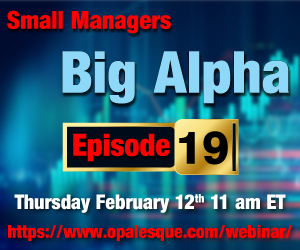
Want to hear more from Edward Lam about his investment approach and the opportunities he's seeing in global banks and financials? Join Edward and his co-panelists Youssef Sbai (Katch Investment Group), Jonathan Jacoby (Tabor Asset Management), and Rob McGregor (Coromandel Capital) for a live conversation at the Small Managers - BIG ALPHA Investor Workshop on February 12th (for qualified investors only).
Register now: https://www.opalesque.com/webinar/
---
IMPORTANT DISCLAIMER: This article is for informational purposes only and does not constitute investment advice or an offer to sell securities. Past performance does not guarantee future results. Investors should conduct their own due diligence and consult with qualified advisors before making any investment decisions. Hedge fund investments involve significant risk of loss and are suitable only for sophisticated investors who can afford to lose their entire investment.
Article source
|





 RSS
RSS