|

B. G., Opalesque Geneva: In anticipation of the 2024 U.S. presidential election and the expected continuation of a high-interest rate environment, hedge fund managers who participated in a recent survey said they were planning bold moves to mitigate risk and maximise alpha potential.
The hedge fund survey was published this month by Dynamo Software, Dakota and ProFundCom.
Nearly half of hedge fund participants said they plan to diversify their investment allocations across multiple asset classes over the next 12 months.
They named the top five geopolitical and economic factors influencing these expected moves as follows: interest rates, the U.S. presidential election, geopolitical conflicts, economic recession and global trade tensions. They are prioritising economic and geopolitical factors over ESG criteria and climate policies, which indicates a strategic realignment in response to uncertainties.
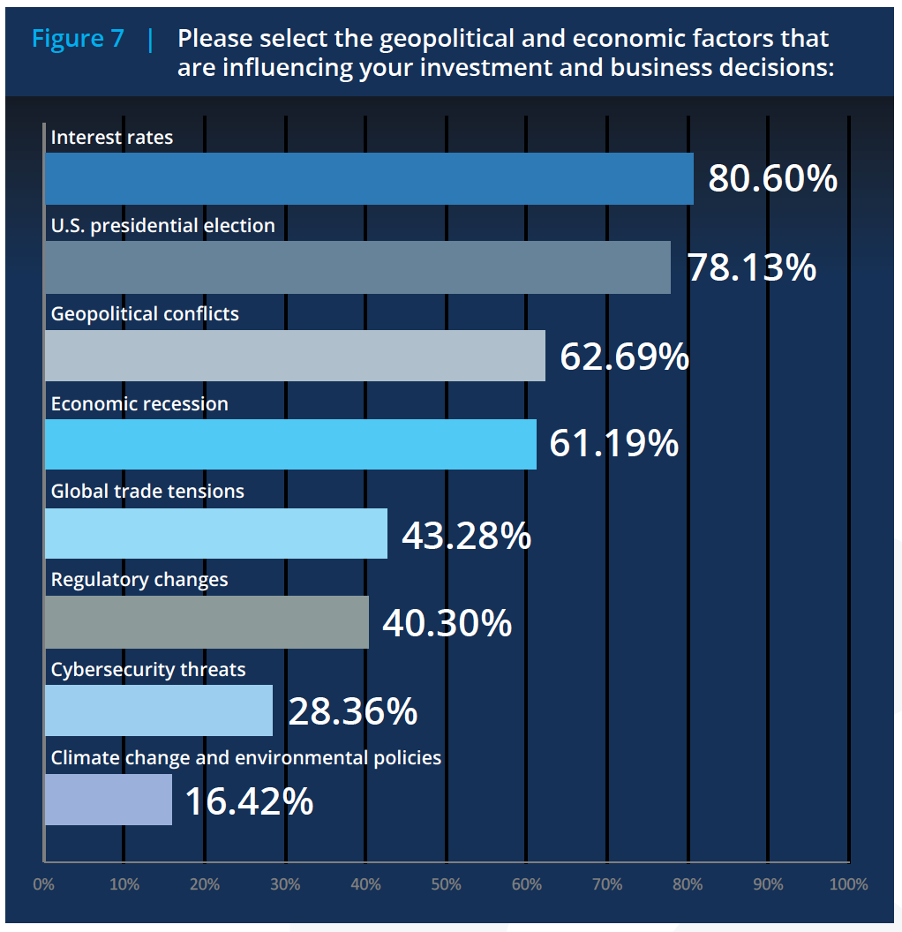
Source: 2024 Hedge Funds - Dynamo Frontline Insight Report: Trends, Challenges & Insights from Leading Hedge Funds
2024 U.S. presidential election
The focus on
the 2024 U.S. presidential election, to be held in November,
underscores the significant impact
political events have on market
conditions and investment strategies, says the report.
Hedge funds are likely preparing
for the volatility and opportunities
that such a political milestone could
introduce, affecting everything from
regulatory environments to market
sentiment.
This year, investors are most interested in the different ways that Joe Biden and Donald Trump will address the big economic issues. According to global private banking group LGT, both parties are expected to want to reduce the deficit. Under a Biden administration, the Democrats would likely try to curb the deficit by increasing taxes for corporations and the wealthy. They may also let Trump's 2017 tax cuts expire in 2025 and then increase spending, especially for social programmes. A Republican administration under Trump would likely include continuing the deregulatory agenda he started in his first term and upholding the lower tax rates introduced at the time. The Republicans would probably also focus on other areas of fiscal policy, and, for example, strive to reduce government debt by cutting certain spending programmes rather than raising taxes.
Interest rates
The surveyed hedge fund managers' emphasis
on interest rates points to the
fundamental role economic policies
and conditions play in shaping
investment strategies, Dynamo's report adds. With interest
rates directly impacting the cost of
borrowing and the overall economic
growth, hedge funds seem to be
bracing for the potential challenges
and opportunities that arise from
changes in monetary policy.
For most of the past decade, the hedge fund industry faced headwinds to generate alpha as subdued volatility led to fewer trading opportunities and a near-zero interest rate environment hindered the asset price discovery process, according to investment bank Goldman Sachs. Historically, the hedge fund industry has displayed a strong positive relationship between higher inflation, higher interest rate regimes and better hedge fund performance. In periods marked by low inflation, hedge funds' absolute returns were half that of US equity market returns. In periods of high inflation, it was the other way around. When inflation has been close to the Fed's long-term target of 2%, hedge fund returns were roughly in line with equities but with significantly lower volatility due to the relative value orientation of many strategies.
The annual inflation rate for the US was 3.4% for the 12 months ending April 2024, compared to the previous rate of 3.5%.
Since March 2022, the Federal Reserve has raised short-term interest from 0% to over 5%. From a structural perspective, hedge funds stand to benefit from the higher-rate environment, particularly those strategies that use derivatives and short selling, reports Plante Moran, a wealth management firm. Credit strategies can also expect to have better prospective returns since they tend to be long and (to varying degrees) own performing levered loans and high yield bonds. Higher interest rate environments may also provide more stressed and distressed opportunities, a large component of the "event-driven" category.
Last summer, the banking group BNP Paribas surveyed hedge fund investors in light of the high risk-free rates, and nearly half said they would be making strategy allocation changes with credit, CTA and discretionary macro being the largest benefactors.
Register to the webinar here.
|





 RSS
RSS