


 RSS
RSS
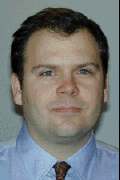
Kevin, can you tell us about Ferro Capital?
One the primary goals in establishing Ferro Capital was to create an entirely independent investment management firm. Ferro Capital is focused exclusively on providing our clients with access to “super-premium” hedge fund managers through diversified funds-of-hedge funds. Ferro Capital is a registered investment adviser with the US Securities and Exchange Commission. Before founding Ferro Capital, I was the Global Head of Alternative Investment Strategies for Commerzbank, where my team and I started and built the bank’s alternative investments business, including introducing the first-of-its-kind German hedge fund Certificate, “COMAS I”. Before that, I worked for D. E. Shaw & Co., a well-known multi-strategy quantitative hedge fund firm headquartered in New York.
Can you go into more detail about your investment philosophy?
Ferro Capital’s overarching philosophy is to build diversified portfolios that pursue consistent returns with relatively low correlation to major equity and bond markets, and low volatility. Our focus is to offer our investors a tool to improve the risk-return profile of their overall investment portfolios through an allocation to high Sharpe Ratio fund-of-hedge funds programs.
In order to achieve this, we have designed and implement very thorough diversification across many factors. The firm’s portfolios are typically both multi-strategy and multi-fund. We seek to invest with unique and particularly accomplished fund managers, pursuing a range of hedge fund strategies that often exhibit low correlation to one another, including among others: convertible bond arbitrage, equity arbitrage, fixed-income arbitrage, event-driven strategies, systematic futures strategies, long/short strategies and global macro strategies.
Within each strategy, we seek to allocate to individual managers that are more or less uncorrelated to one another, depending on the risk-return objectives of the client. In general, though, we are biased toward managers that exhibit more “systematic” and more “repeatable” processes, and we are always looking for managers that are in at least one way distinguished from their peers. We describe our goal as the identification of “super-premium” managers.
What do you think explains your success?
I think at least one of the keys is that I and other members of my team have experience working inside hedge funds. For instance, I started out with a quantitative hedge fund firm, D. E. Shaw & Co., in 1994. I became involved in D. E. Shaw’s fund-of-funds, which was based on the concept that, as a hedge fund manager ourselves, we were uniquely positioned to identify and evaluate other hedge fund managers in our chosen strategies. An intimate familiarity with hedge fund strategies and operations is surprisingly rare in this industry, and we believe gives a real edge in identifying, analyzing and selecting “super-premium” hedge funds.
Kevin, congratulations on being named Best Specialist Provider for Hedge Fund Investments in Germany by Euromoney. Can you tell me about your involvement in Germany?
While I was the Global Head of Alternative Investments at Commerzbank, among other things, my team and I spent a great deal of time focusing on the bank’s German clientele, and in fact created the first hedge fund Certificate for German investors at the beginning of 2000, called “COMAS I”, which went on to gain an excellent reputation in the German market for its novel structure and risk-adjusted performance. After leaving Commerzbank to found Ferro Capital in 2001, we discovered that a large audience of investors in Germany had followed our successes at Commerzbank, and wanted access to our programs, so in December 2002 we launched the first of a series of Certificates for the German market in partnership with Merrill Lynch, and have been pleased and flattered by the enthusiasm of German investors for these products. Our firm has a global focus for our products, but we also feel we have a special relationship with Germany, which we expect to get stronger over time.
So I guess you could say that you are the father of the German hedge fund Certificate! What do you think are the most important developments/trends for you in the hedge fund industry?
I believe that one of the most significant trends in the hedge fund industry is that the percentage of “super-premium” hedge fund managers is declining on a percentage basis. That is, new hedge funds are established everyday, but the growth in the number of high quality hedge fund management firms is much smaller than that of the overall industry. This trend of increasing numbers of “average” quality hedge funds puts a premium on careful due diligence processes, like the one Ferro Capital strives to conduct, in order to identify the best managers.
With this said, Ferro Capital has access to what is believes is a sizable amount of “super-premium” hedge fund capacity, due to its years of research and the quality of its relationships. In addition, the Ferro Capital team interviews hundreds of hedge funds every year in an effort to identify new developments among existing funds and new talent.
Finally, we are committed to accepting no more capital than we can allocate to what we believe are “super-premium” hedge funds, as we are entirely focused on delivering the best risk-return profile possible to our clients.
What are the most significant challenges the hedge fund industry has to deal with?
Setting proper client expectations is probably one of the most important issues the hedge fund industry has to deal with at the moment. As people become increasingly interested in hedge funds, it is important for them to understand that different hedge fund managers, strategies and hedge fund products (such as funds-of-hedge funds) can have very different risk-return profiles. There seems to be a tendency for over-simplification and over-generalization with hedge funds—and many are under the impression that all hedge funds, regardless of philosophy, strategy or implementation, are striving to deliver a homogeneous risk-return profile. The fact is, very different risk-return profiles can be targeted—some more speculative, some more conservative. In addition, some managers of hedge fund products aim to focus their clients purely on the return potential of their programs. Others, such as Ferro Capital, attempt to focus clients on risk-adjusted returns or more specifically the “risk characteristics” of their programs—e.g., focusing on low volatility relative to the equity market and/or low correlation/beta to the equity or bond market. We think that setting correct expectations and delivering these results over time have been among the most important factors that have helped set our firm apart from the competition.
Company website:
www.ferrocapital.com
